Separating partial discharge from electrical noise on a turbo generator —
by exploiting the physics of the interference (cross-channel
coincidence, waveform repetition, switching clocks) before any
expensive model runs. Energy Data Hackdays 2026 · challenge by Axpo.
No ground truth exists for this dataset, so the firewall optimises for the
safe failure mode: reject only multi-channel-confirmed common-mode noise, keep lone
high-SNR pulses, and send everything ambiguous to review instead of guessing.
14.4%
fast-rejected as common-mode interference
40.2%
kept as PD candidates (lone + high SNR)
45.5%
UNKNOWN → heavy stage / expert
4.0%
high-SNR pulses at rejection risk
33 µs
per pulse, whole firewall
~30k/s
pulses/s per core
12.5×
raw-path filter speedup (decimation + ZOH)
0
ML training required for stage 1
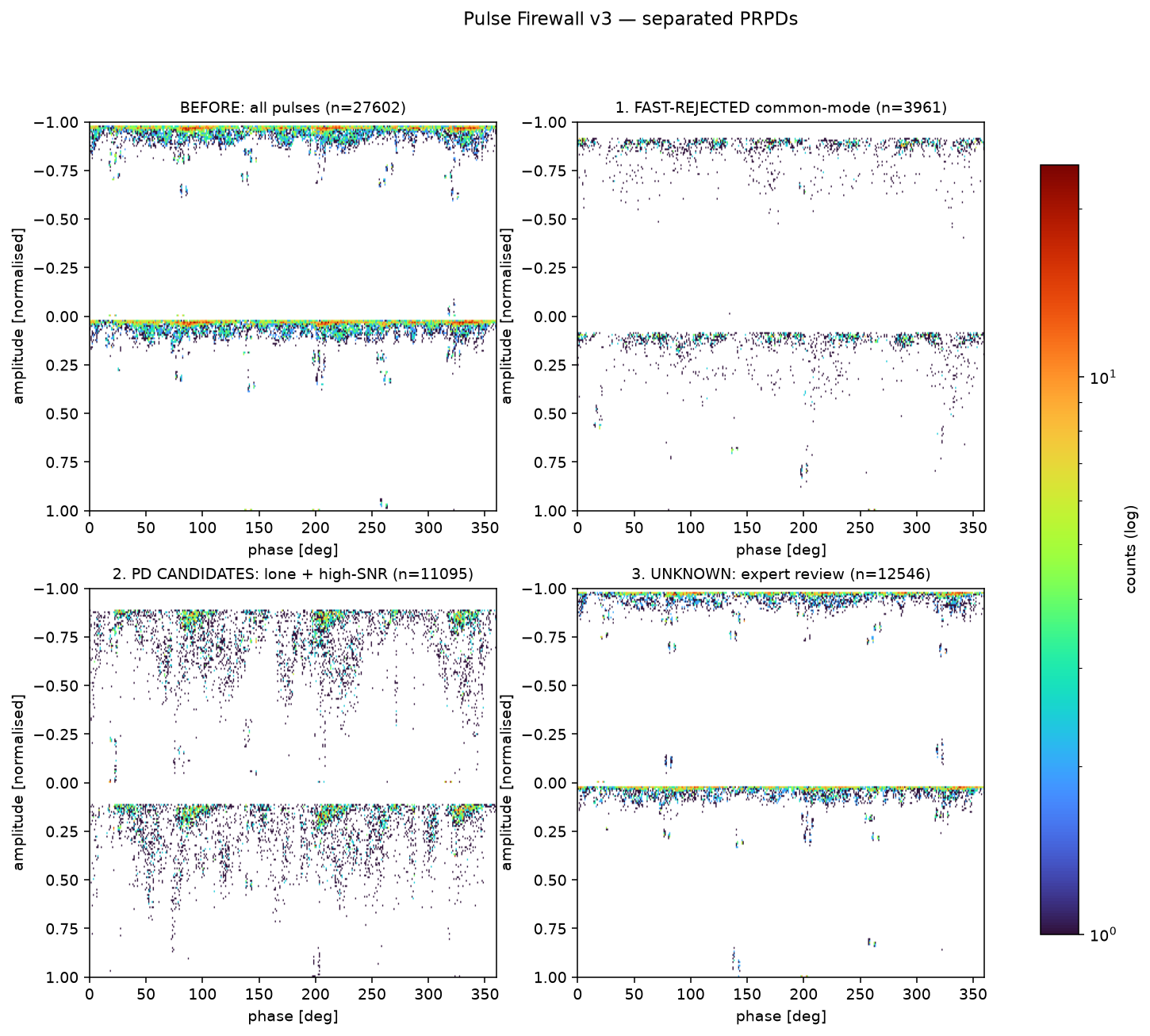
Separated PRPDs. Top-left: everything mixed (the diagnostic problem).
Top-right: rejected common-mode — diffuse, low-amplitude, phase-spread background.
Bottom-left: PD candidates — coherent phase-locked families near 75°/165°/255°/315°.
Bottom-right: UNKNOWN — preserved for expert review, not guessed away.
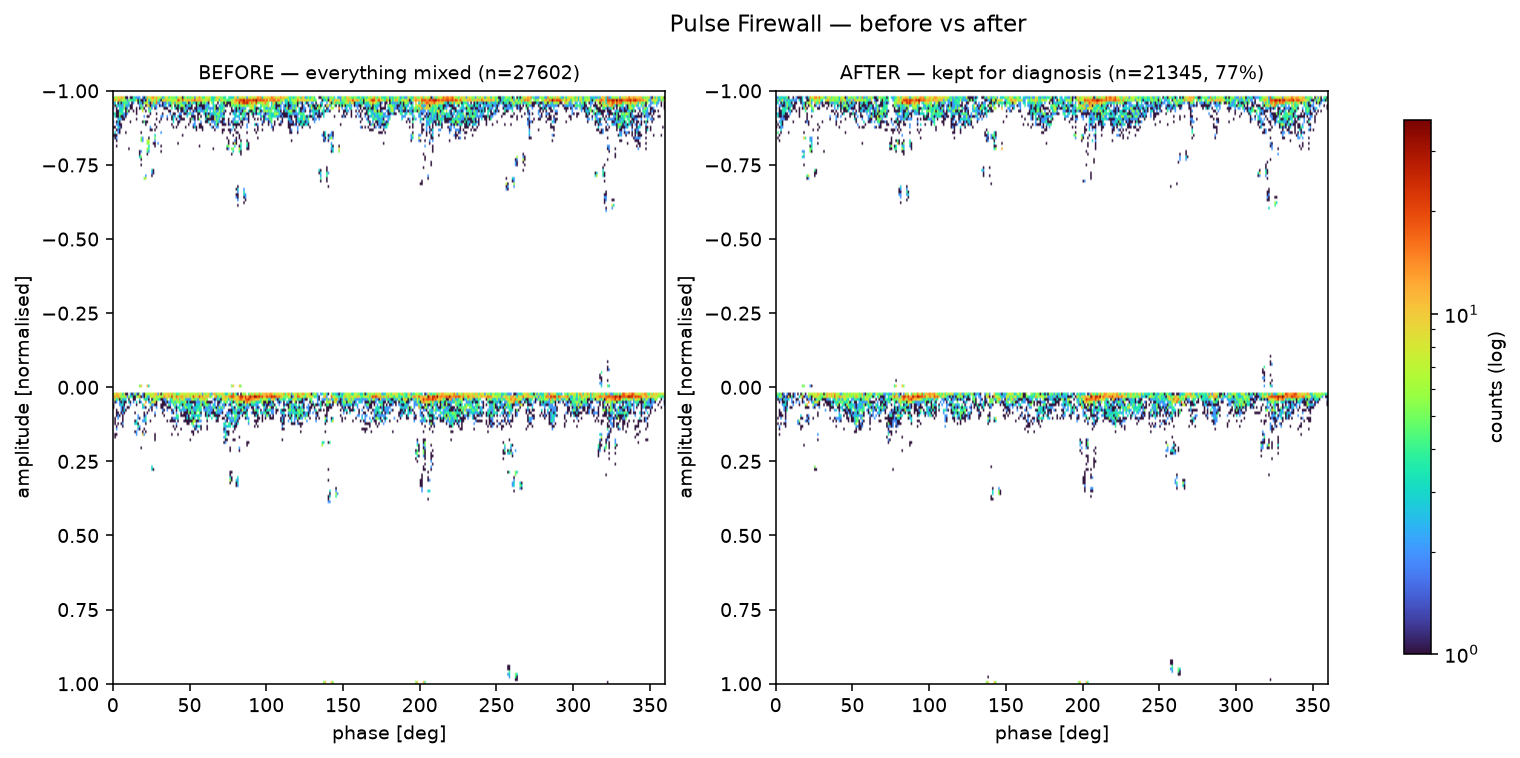
Before vs after. The deliverable view: one unreadable diagram becomes
a clean candidate PRPD plus an auditable rejection panel.
The rules (all explainable, no black box):
REJECT≥2 channel twins within 0.5 µs and amplitude ratio in [⅓, 3] and same polarity — symmetric common-mode; or 1 twin, ratio ≈ 1, low SNR.
KEEPno twin within 0.5 µs and SNR > 3 → PD candidate.
UNKNOWNeverything else — including twin-rich but amplitude-asymmetric high-SNR events (possibly real PD riding on common-mode noise; 1,318 pulses saved by this rule).
02How it works
The interference has physical fingerprints that are cheap to check.
The firewall checks them first; only ambiguity flows downstream.
42% of pulses have a twin on
another channel within 0.5 µs (chance ≈ 2.6%); twins are 84% same-polarity,
amplitude ratio ≈ 0.7, lag ≈ 50 ns → common-mode coupling, not local PD.
Matches EPRI two-coupler practice on turbine generators.
Fingerprint 2 — repetition
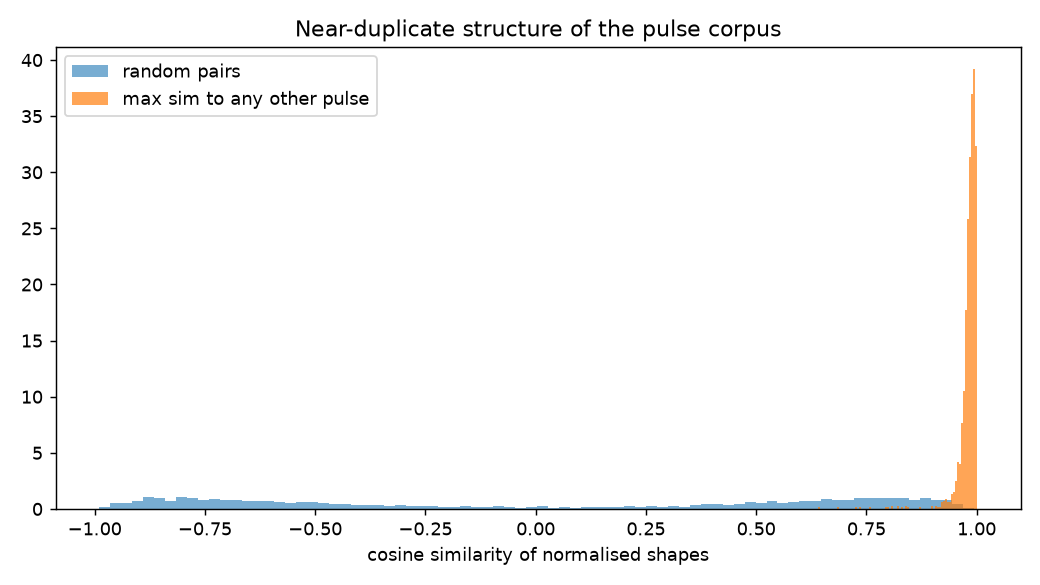
The median pulse has a near-identical
twin (cosine 0.986). Top-10 shape families cover 73% of the corpus —
the interference is a small, enumerable zoo.
Fingerprint 3 — clocks
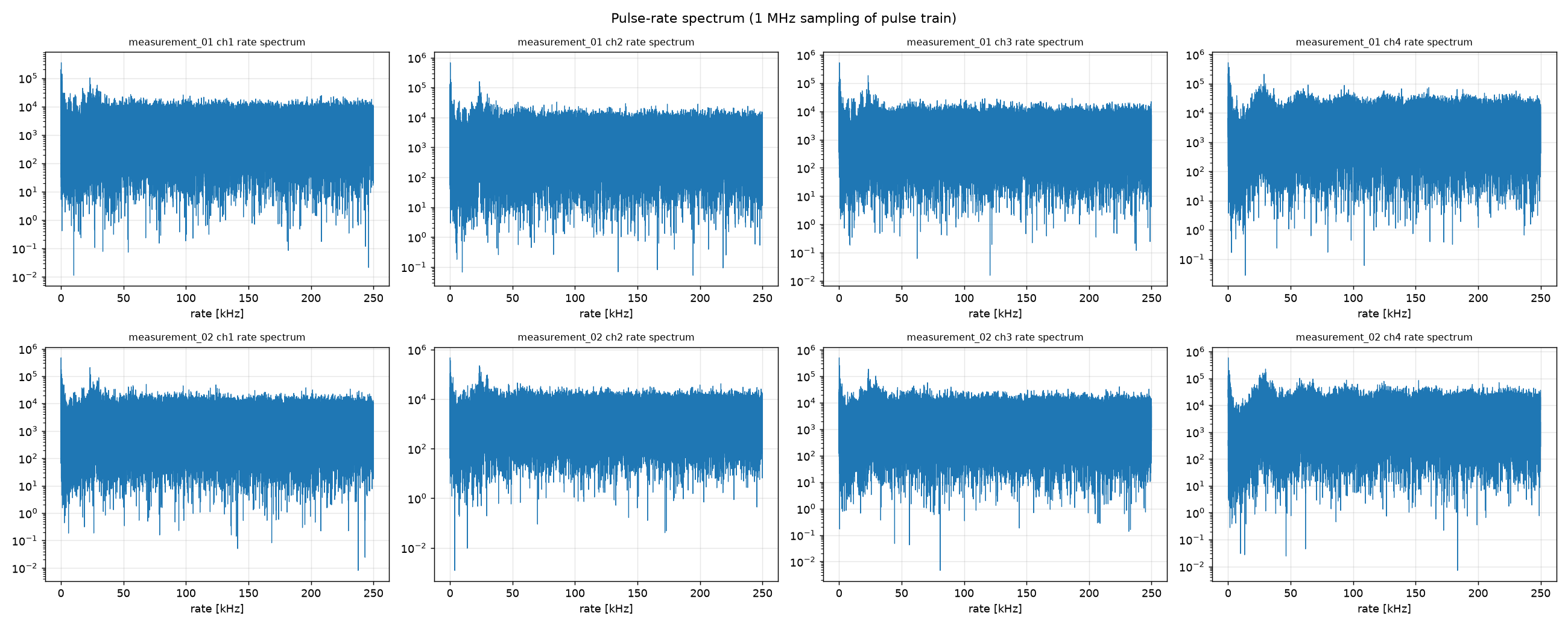
Pulse-rate spectra show lines at
~23–30 kHz on all channels (converter/excitation clocks), and the continuous
background carries a 207.5 kHz-spacing comb — a comb-notch target.
03Interference physics — the evidence
Every claim above, measured. These plots are the audit trail.
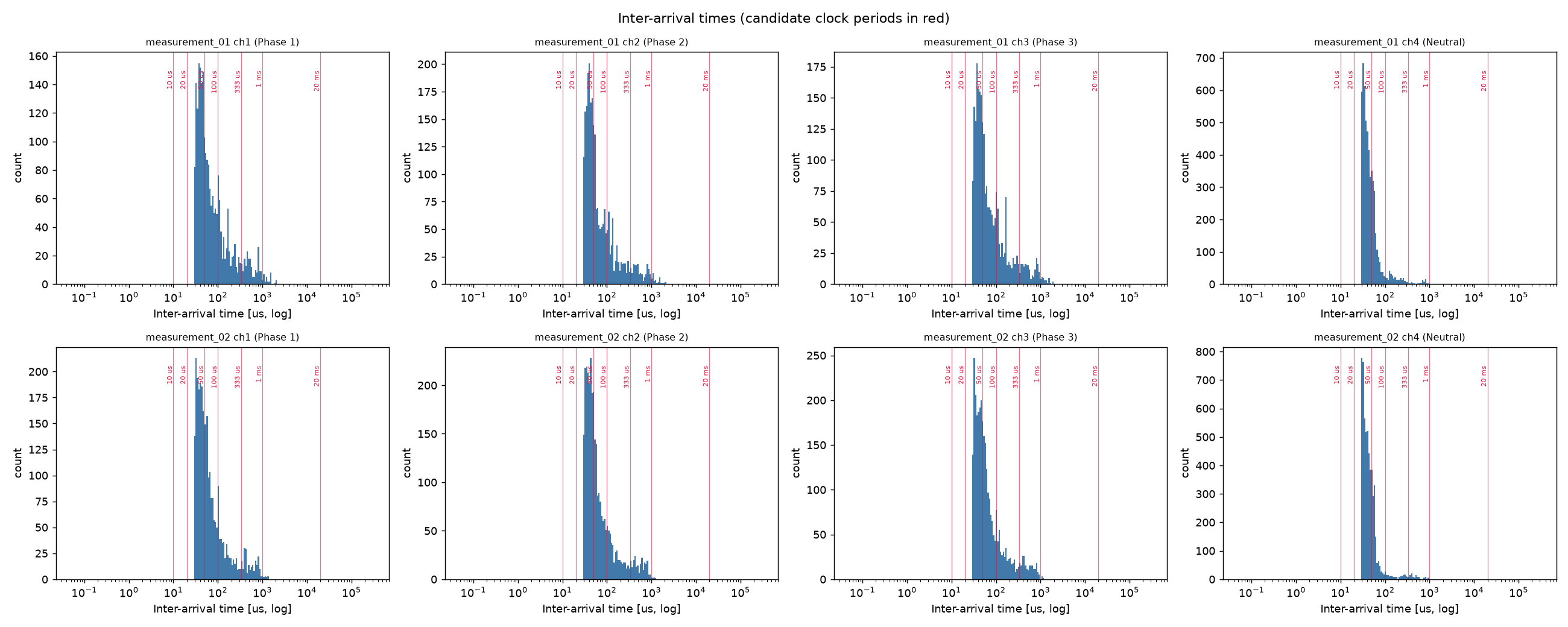
Inter-arrival times. Hard wall at exactly 30.0 µs = the detector's
dead time (3,000 samples) censoring true bursts; burst structure above it.
Rate spectra. Persistent lines at ~23.3, ~23.6 and ~29–30 kHz on
every channel — quasi-periodic burst trains, not a global lock.
Near-duplicate structure. Distribution of the best cosine match per
pulse vs random pairs: the corpus is full of repeated shapes.
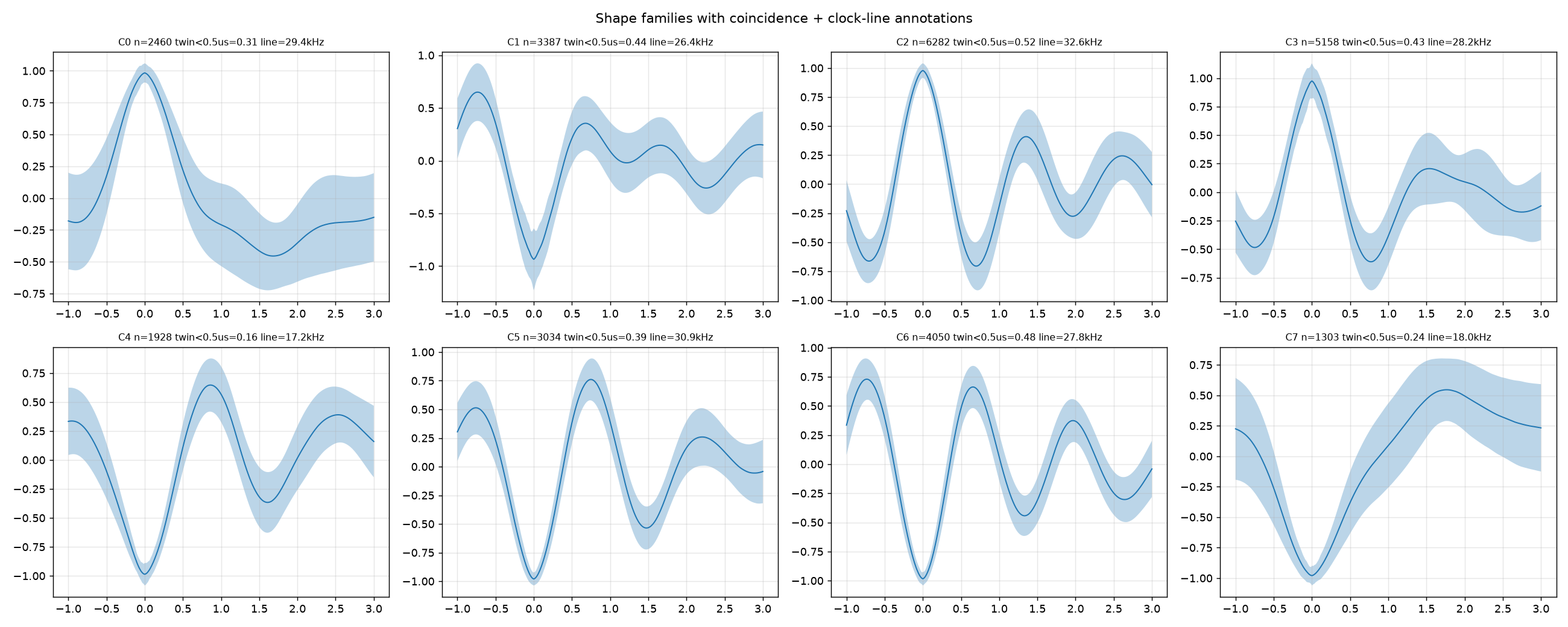
Shape families (k=8). Note C4: 91% Neutral channel, 84% lone — a
local family; C2/C6: phase-spread with 48–52% twin rate — common-mode families.
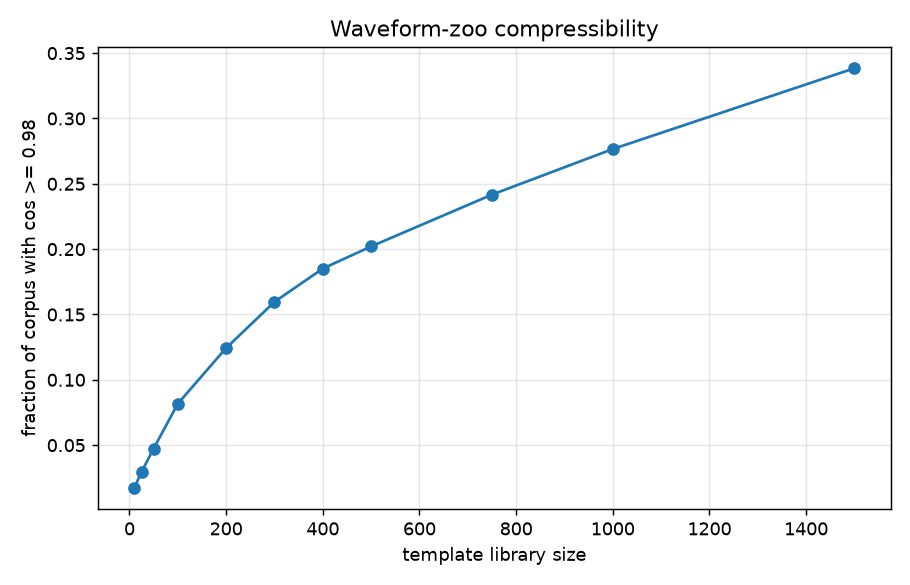
Compressibility. A small expert-labelled library describes most of
the zoo — label families once per machine, not thousands of pulses.
04Raw 100 MHz data — engineering results
The raw measurements arrived mid-hackathon. We reproduced the supplied
baseline bit-exactly (31.5 s wall, 2.35 GB peak RSS for both measurements,
every regenerated field identical), then used the raw streams for speed and spectra.
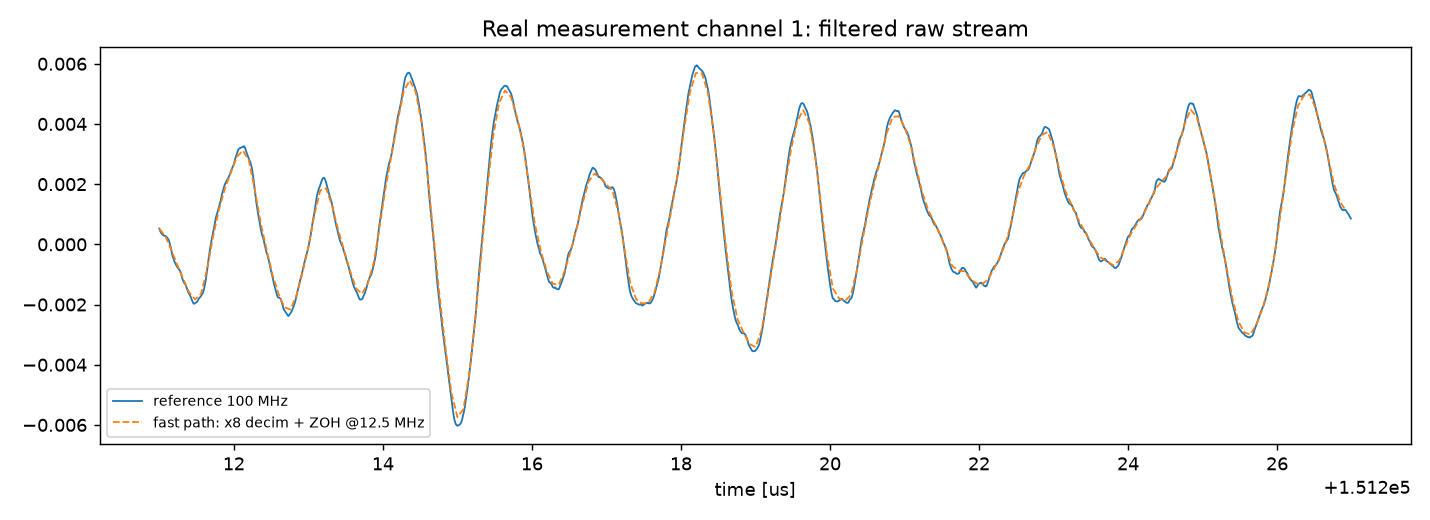
×8-decimated + exact-ZOH filter vs the supplied numba filter on a real
channel: near-identical waveforms. Position error of matched pulses: 30 ns.
Recommendation: two-pass — decimated detector + exact re-filter of ±5 µs event windows.
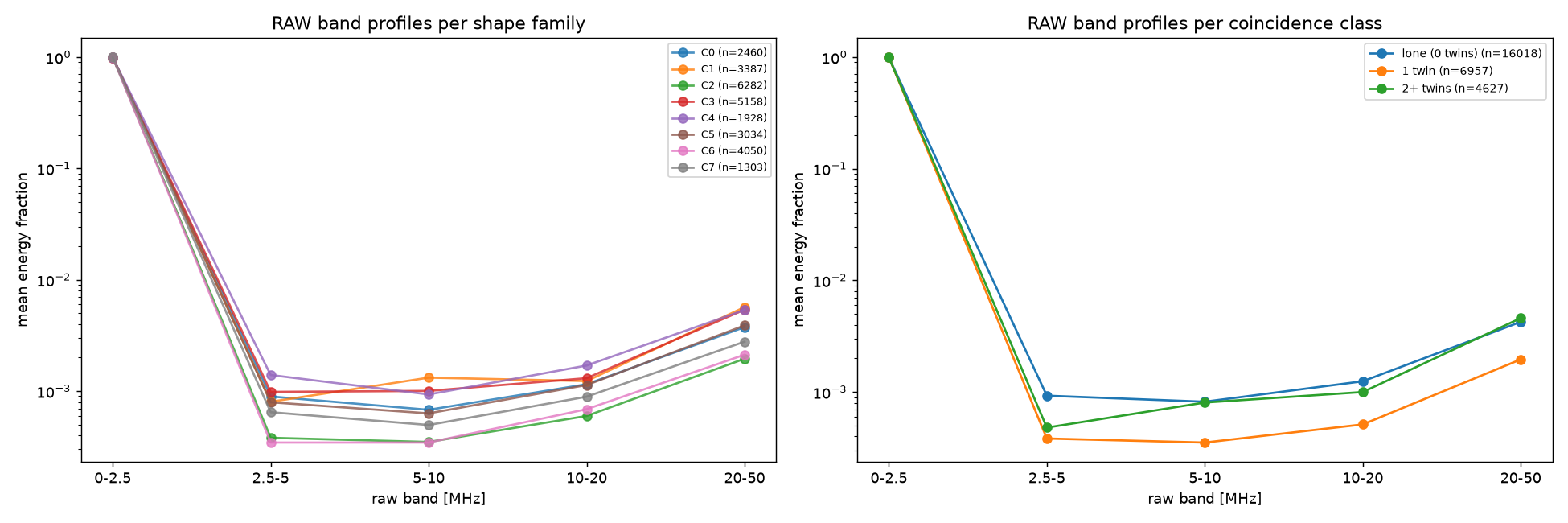
Raw pulse-window band profiles. Even unfiltered windows are >99%
below 2.5 MHz — the analogue front-end sets the band; raw pulse spectra add little.
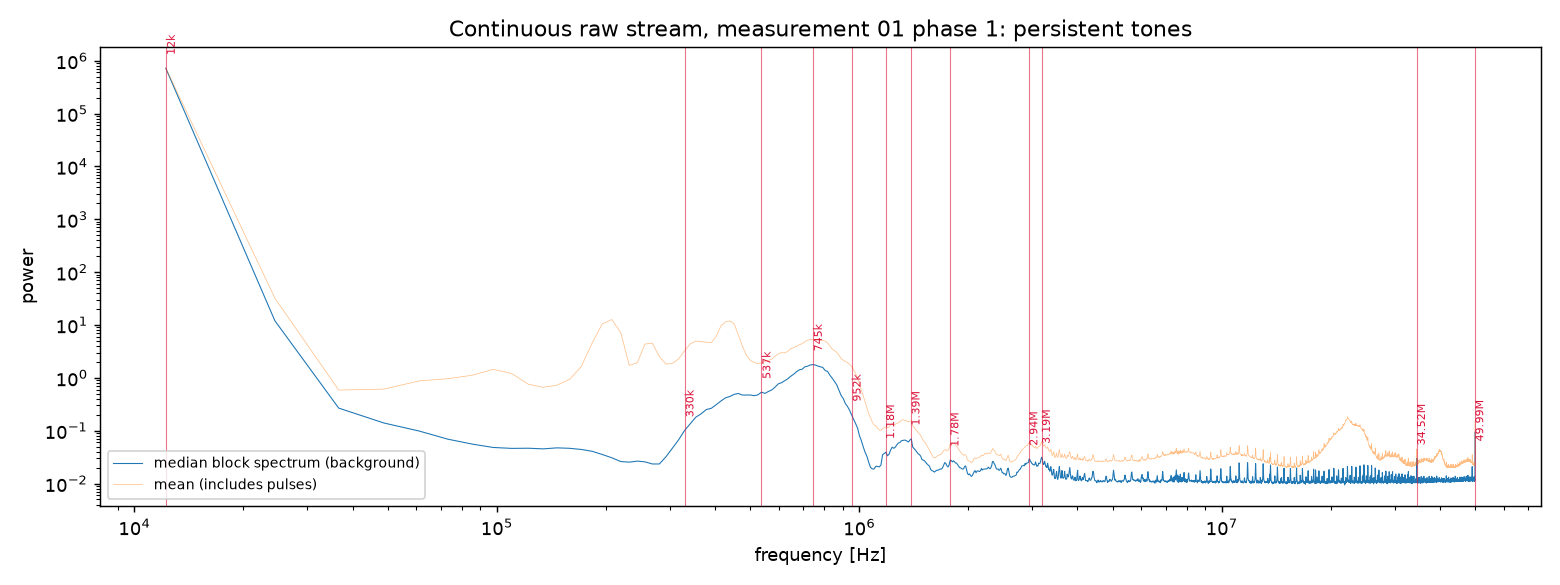
Discovery — switching comb in the continuous background. Median block
spectrum (transients suppressed) shows persistent tones at 329.6 / 537.1 / 744.6 /
952.1 / 1,159.6 / 1,392.2 kHz — constant 207.5 kHz spacing. Natural target for a
comb-notch / adaptive filter. Question posed to Axpo: what switches at ~207.5 kHz?
05The expert prior — "PD where dV/dt is higher"
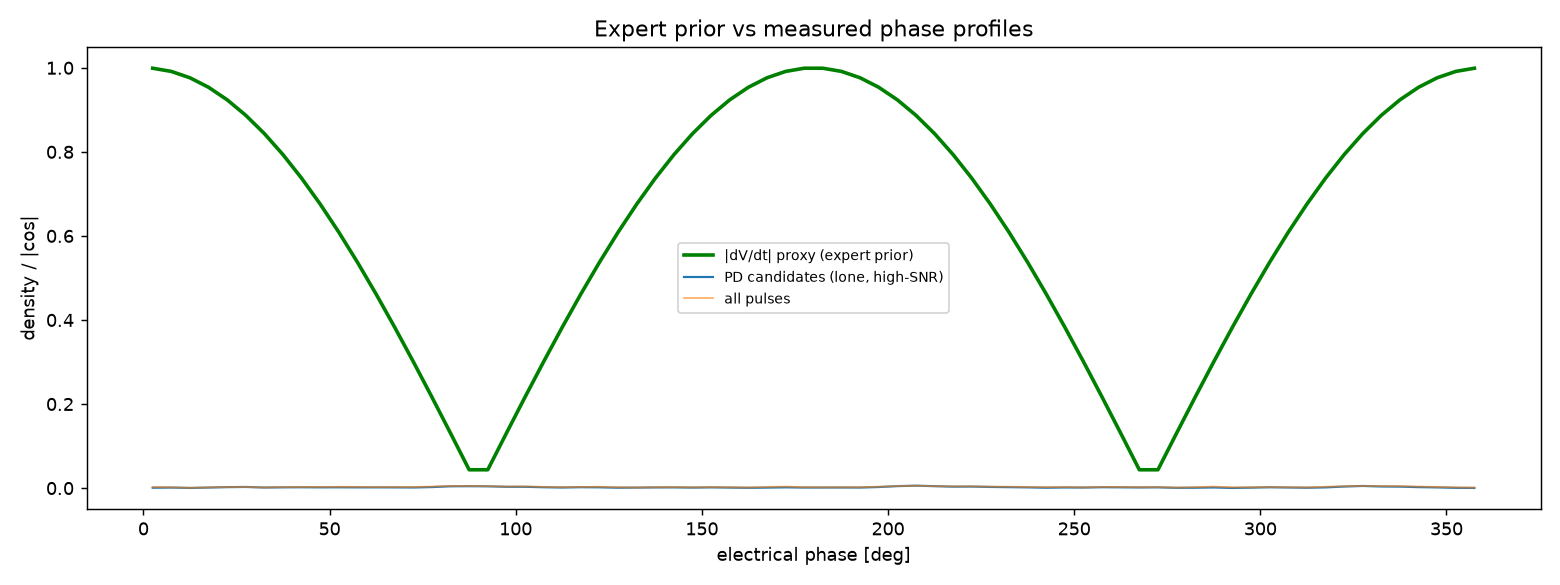
The challenge owner told us PD preferentially occurs where the voltage
derivative is higher — near the zero crossings. We measured it.
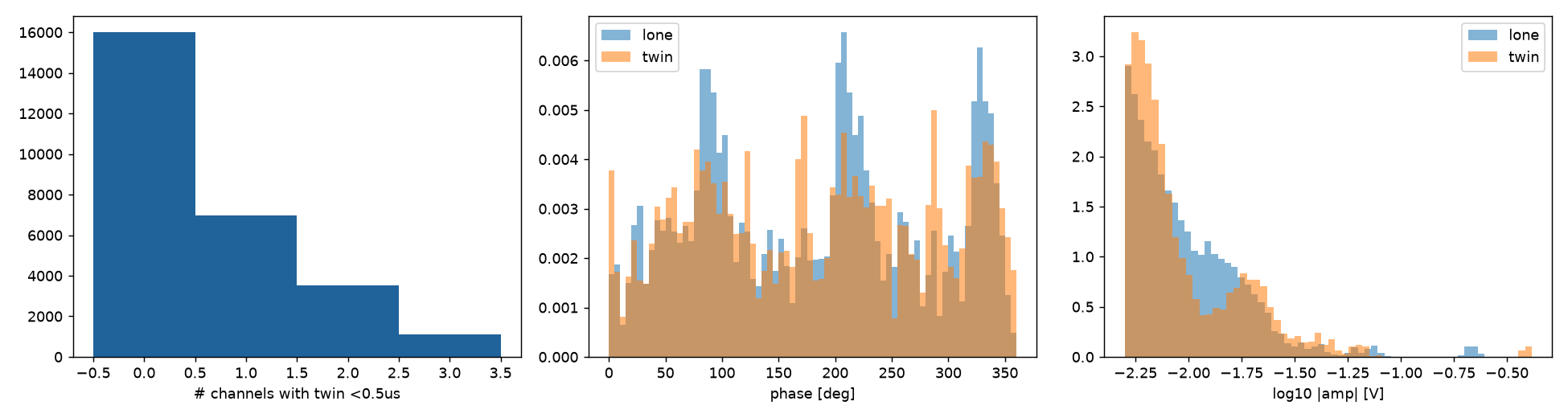
Measured verdict: lone high-SNR pulses do cluster at 0°/180° (both
polarities) — directionally consistent. But mean |cos φ| is ≈ 0.62 for every
route and polarity-vs-slope agreement is 51% (chance): within a single 0.32 s record
the prior does not separate routes, so it is used as a review-ranking prior
(UNKNOWN triage exported ranked by prior × amplitude) and a family-plausibility
feature — not as a hard routing rule.
06Experiment registry
Every experiment logged with method, data, runtime and result — the full
trail is experiments/results.csv plus one self-contained script each.
#
Method
Runtime
Key result
01
Inter-arrival + rate spectra
11.0 s
23–30 kHz lines all channels; 30 µs dead-time wall
02
Fine periodicity + lead/lag
7.6 s
Near-clock pulses 8–15%; twins lag 50 ns
03
Near-duplicate + k-means sweep
6.2 s
Median twin cosine 0.986; k=4 silhouette 0.357
04
Families × coincidence
17.1 s
C4 lone-neutral family vs phase-spread common families
All routes await expert judgement
on the separated PRPD panels. The UNKNOWN share (45.5%) is the price of not guessing.
Machine dependent by nature
PD patterns are machine specific
(this machine: turbo, 50 Hz / 3,000 rpm). Interference physics transfers; the
shape-family library is re-learned per machine in minutes.
Detection artefacts
30 µs dead time and the 5 mV threshold
censor the underlying signal; both are baseline parameters an Axpo review should
revisit.
Amplitudes on the fast path
The ×8-decimated detector needs
per-band calibration or the two-pass exact re-filter before production amplitudes
are trusted.